
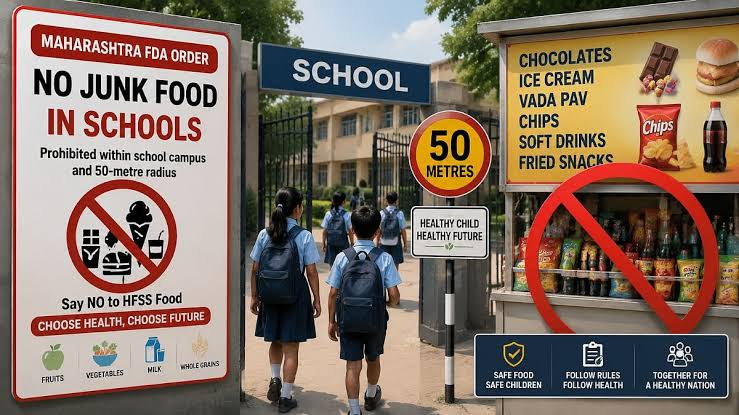
Every parent wants their child to grow up strong, focused, and healthy. But between chips in the school bag and vada pav stalls outside the gate, junk food has quietly become part of everyday school life. Maharashtra’s Food and Drug Administration (FDA) has now stepped in with a new rule aimed at changing that.
If you are a parent in Daund searching for schools that care about your child’s overall well-being, this update is worth understanding.
What Are Maharashtra’s New FDA Rules?
The Maharashtra FDA has issued an order banning the sale, advertisement, and free distribution of junk food inside school premises and within a 50-metre radius of any school campus. The order was issued to enforce food safety and nutritional standards across educational institutions, and the FDA Commissioner said it would be implemented strictly.
The rule targets foods high in fat, trans-fat, sugar, and salt, commonly known as HFSS foods, which cannot be sold, promoted, or distributed within school premises or within 50 metres of any school. This includes everyday items such as:
- Chips and packaged fried snacks
- Chocolates, candies, and toffees
- Cold drinks and carbonated beverages
- Samosas, vada pav, and other deep-fried street food
- Ice cream and sugary desserts
The directive covers packaged chips, sugary drinks, carbonated beverages, chocolates, confectionery, instant snacks, and other ultra-processed foods widely consumed by schoolchildren.
The rule applies to all educational institutions, including government, aided, private, and residential schools, as well as those affiliated with CBSE, ICSE, State Board, and other boards. The FDA has also directed that every school kitchen operator and food supplier to schools must hold proper licenses under food safety regulations, and canteens, midday meal kitchens, and hostel kitchens must obtain mandatory registration.
The move is expected to impact nearly 1.08 lakh schools and around two crore students across the state.
Why Are These Rules Important for Children?
The initiative aims to create a healthier food environment around schools and address the growing burden of childhood obesity, diabetes, and other lifestyle-related diseases linked to unhealthy diets. This is not just a policy update — it reflects a real health concern.
Children who eat too much sugar, salt, and fried food regularly are more likely to:
- Struggle with weight gain and obesity
- Feel low on energy during school hours
- Face difficulty concentrating in class
- Develop early signs of lifestyle diseases like diabetes
Nutritionists have long pointed out that junk food with high fat, salt, and sugar but very little nutritional value can lead to obesity, dental problems, diabetes, and heart issues later in life. Good nutrition, on the other hand, supports better memory, mood, and physical stamina — all things a growing child needs to do well in school and in life.
How Parents and Schools Can Encourage Healthy Eating
Rules alone cannot change habits overnight. Parents and schools need to work together to build lasting routines. Here are a few simple ways to start:
At home:
- Pack home-cooked tiffins instead of packaged snacks
- Keep fruits, nuts, and simple homemade snacks handy
- Limit sugary drinks and replace them with water, buttermilk, or coconut water
- Talk to children about why healthy food helps them play and study better
At school:
- Offer nutritious canteen menus with fruits, vegetables, whole grains, and dairy
- Avoid promoting or selling packaged junk food on campus
- Educate students about food labels and healthy choices
- Encourage physical activity alongside better eating habits
Small, consistent changes at home and school make the biggest difference over time.
How Sanskar Primary & High School Promotes Healthy Habits
A school’s role goes beyond textbooks and exams. At Sanskar Primary & High School, Daund, located in Chandrabhaga Nagar near Axis Bank, the focus has always been on the complete development of every child — academics, discipline, values, physical fitness, and personal well-being.
The school encourages students to build good daily habits, including mindful eating, regular physical activity through sports, and a disciplined routine that supports both body and mind. Since Sanskar follows an English medium curriculum from Pre-Primary to High School, this focus on healthy habits is introduced early, when children are most likely to carry it forward into adulthood.
For parents in Daund looking for a school where academics and well-being go hand in hand, this kind of holistic approach matters just as much as classroom results.
Final Thoughts
Maharashtra’s new FDA rule on junk food near schools is a welcome step toward protecting children’s health. But true change happens when parents, schools, and children work together, at home and in the classroom, to build habits that last a lifetime.
Choosing a school that values your child’s overall well-being, not just marks, can make this journey easier. If you are exploring schools in Daund that combine strong academics with healthy, disciplined routines, it’s worth learning more about what Sanskar Primary & High School has to offer.
Admissions are currently open at Sanskar Primary & High School, Daund. Visit the school or reach out today to learn more about admissions and how we support your child’s complete growth — academically, physically, and personally.
FAQs
1. What is the Maharashtra FDA junk food ban near schools?
It is an FDA order banning the sale, advertisement, and free distribution of high fat, sugar, and salt (HFSS) foods inside schools and within 50 metres of school campuses across Maharashtra.
2. Which foods are considered junk food under this rule?
Items like chips, chocolates, cold drinks, samosas, vada pav, ice cream, and other packaged or fried sugary snacks fall under this category.
3. Does this rule apply to all schools in Maharashtra?
Yes, it applies to government, aided, private, and residential schools affiliated with any education board, including those in Daund.
4. Why is this rule important for children’s health?
It aims to reduce childhood obesity, diabetes, and other lifestyle diseases by encouraging healthier eating habits from a young age.
5. How can parents support healthy eating at home?
Parents can pack home-cooked meals, limit sugary snacks and drinks, and involve children in choosing nutritious food options.